Chard deNiord
Poet Laureate of Vermont (2015-2019)

Chard deNiord is the author of nine books of poetry, most recently, This Ecstasy (forthcoming from Slant, 2026), Westminster West (Tupelo Press, 2025), One As Other (Green Writers Press, 2024), and In My Unknowing (University of Pittsburgh Press, 2020).
He is also the author of three books of interviews with eminent American poets: Sad Friends, Drowned Lovers, Stapled Songs (Marick Press, 2011), I Would Lie To You If I Could (University of Pittsburgh Press, 2018), and Learning To Be Everyone And No One (forthcoming from The University of Alabama Press, 2026).
He is the former Poet Laureate of Vermont (2015-2019), Professor Emeritus of English and Creative Writing at Providence College, co-founder with Gerald Stern and Jacqueline Gens of The New England College MFA Program In Poetry, and cofounder of The Spirit And The Letter Writing Workshop in Patzcuaro, Mexico, with Jacqueline Gens and Thomas Lux.
He lives in Westminster West, Vermont with his wife, Liz.
Recent Books and more
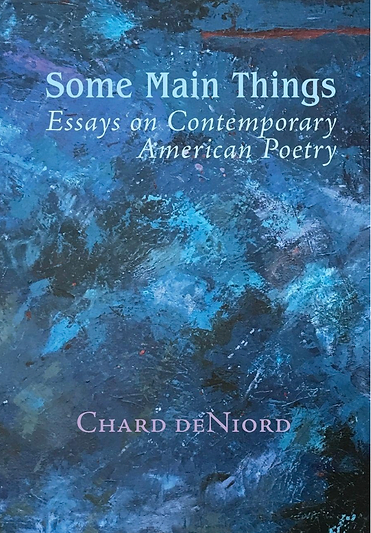
Some Main Things
Some Main Things is an eclectic collection of twenty-six essays on a broad range of American poets and their work. The author of nine volumes of poetry, Chard deNiord has long sought “to assuage any ‘anxiety of influence’ in my own poetry-writing by immersing myself in the work of myriad other poets.” In these essays, he writes with well-honed critical acumen about progenitors like Emily Dickinson, Walt Whitman, Robert Frost, Elizabeth Bishop, and Robert Lowell, as well as poets of his own generation, many of whom he has interviewed at length—Lucille Clifton, Louise Glück, Charles Simic, Philip Levine, and Ruth Stone. “Each new reading of their poems,” deNiord explains, “deepens my conviction that they sustain and update what Walt Whitman called ‘the aboriginal strength of American poetry.’” Whitman himself once challenged “Poets to Come” to stay focused on “the main things”; deNiord’s essays demonstrate how well they have succeeded. * * * Chard deNiord has compiled a lifetime of dazzling insights into the foundation and practice of contemporary poetry. This book is an erudite initiation for the student, a guide for the perplexed, and a mystery voyage for the practiced reader. DeNiord’s prose is charged with what poems aspire to: “negative capability,” the ability to remain radically open to a world which will never know us. These essays thrill to the joy of exploration rather than the thud of judgment. Henri Michaux said that “the will is the death of art,” and we all know critical prose that demonstrates its own expertise while leaving its subjects flattened, emptied of the unsayable. DeNiord stands with Walt Whitman, who wrote, “Not to-day is to justify me and answer for what I am.” These essays burn with the fierce life and questioning itch of their subjects.… Poetry is a naked art. It requires only a pencil stub and the back of a utility bill. Or a twig for scratching in the dust. It’s solitary, riddled with silences—between lines, between stanzas. DeNiord writes, “Like Eros, it was born poor and has remained so to keep its blessing.” Poetry stands helpless before the final questions and may take on their power. Why do we love and destroy? How can we understand the night sky and still be tongue-tied before death? —D. Nurske, from the Foreword
This collection bears witness to ecstasy and grief through persona. By inhabiting the voices of Adam and Eve, Abelard and Heloise, etc., deNiord reveals the enduring alterity contained within the self. Westminster West traverses the worlds of here and beyond. Chard deNiord divines “the everydayness of the mystery . . . in which being and making poetry are the same.” From posthumous correspondence between Abelard and Heloise to such poems as “Skywriting Over The Rockies,” “With A Bone In My Heart,” and “I Call Out To You,” this collection betrays a mortal charge, bearing witness to what Emily Dickinson called “each ecstatic moment/ to which we must an anguish pay” and which Aridjis in his defiance of death calls “dust in love.” Ambitious and masterful, deNiord renders such ancient subject matter as love, betrayal, landscape, loss, grief, aging, and ecstasy new throughout Westminster West. He transforms the echo chamber of futility, silence, and failure by aspiring to cross over to “the other,” whatever it may be, a stone or cloud or lover or garment, or cancerous lung, with a “negative capability” that allows it, no matter its identity, to speak memorably in a way that transcends simple definition and ultimately any personal connection to it. Westminster West is divided into three sections that complement each other in their archetypal themes which range historically, mythologically, and cathectically. The poems in the first section imagine correspondences and dialogues between couples, including Heloise and Abelard, Adam and Eve, Gilgamesh and Enkidu, Odysseus and Calypso, a widower and his deceased wife in the time of Covid, and a lovesick husband in the air above the Rocky Mountains and his beloved on the ground. The second section also features love poems but focuses on more instructional and metaphysical themes that vary from metaphorical pedagogy on the topic of sex to “the harsh advice of loss” to the memory of a young couple’s transcendent, romantic walk by a river. Section three moves away from love poems to mortal and environmental themes, including elegies, pastorals, and a concluding confessional credo on the bittersweet reality of poetry’s irony and blessing.

Heading 1
Westminster West
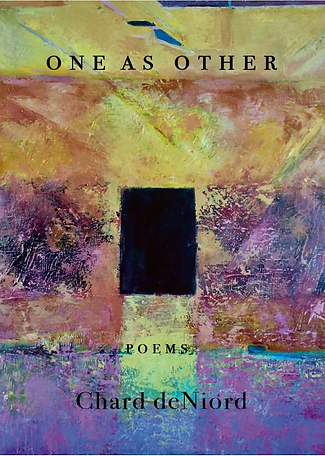
One As Other
One as Other is a 2024 poetry collection by Chard deNiord, known for its minimalist style, precise diction, and musicality, exploring themes from nature and politics to philosophy and religion through brief, non-narrative poems that create surprise and deeper meaning through subtle shifts. Published by Green Writers Press, the book uses techniques like alliteration and internal rhyme to create a "verbal equivalent of a Zen master's paintings," capturing fleeting moments that expand into something larger.
BOOKS 2020 and before

"In My Unknowing, Chard deNiord’s sixth collection of poems, we find ourselves in a world beheld by the spark of seeing, on the border of Platonic emission: a world of salt sorrow and red lust, coterminous with everything at once. To read these poems is to float at a holy distance over the earth, herein recognized as the heaven it has always been, as no other place would do for living forever. It is a world about to evanesce, but is as yet legible to us in these masterful poems, which are in themselves a species of musical awareness."
—Carolyn Forché

Interviews with 10 American Poets
I Would Lie To You If I Could Interviews with 10 American Poets I Would Lie To You If I Could contains interviews with nine eminent contemporary American poets (Natasha Trethewey, Jane Hirshfield, Martín Espada, Stephen Kuusisto, Stephen Sandy, Ed Ochester, Carolyn Forche, Peter Everwine, and Galway Kinnell) and James Wright’s widow Anne, presents conversations with a vital cross section of poets representing a variety of ages, ethnicities, and social backgrounds. The poets testify to the demotic nature of poetry as a charged language that speaks uniquely in original voices, yet appeals universally. As individuals with their own transpersonal stories, the poets have emerged onto the national stage from very local places with news that witnesses memorably in social, personal, and political ways. They talk about their poems and development as poets self-effacingly, honestly, and insightfully, describing just how and when they were “hurt into poetry,” as well as why they have pursued writing poetry as a career in which, as Robert Frost noted in his poem “Two Tramps in Mud Time,” their object has become “to unite [their] avocation and [their] vocation / As [their] two eyes make one in sight.” More Praise Past praise for Sad Friends, Drowned Lovers, Stapled Songs I think it's Chard deNiord's intelligence and empathy as a questioner which help his subjects—some of our best-known and most-respected senior poets—seem to make discoveries about themselves before our eyes. This collection of interviews about what it is to live and think as a poet, along with lucid critical essays, make for a very useful and also very lovely book. Daisy Fried An exhilarating tutorial in what compels the creative soul to seek truth through crafting words into poems.

“Interstate seamlessly connects the state of knowing, in a worldly sense, to that knowing that is deeply felt yet unbodied. The precise attention to the ordinary things of the world, and in particular to the natural world, gives way to the wisdom of the spirit undergirding these searching poems. Reading them, I felt the delights of language in each new revelation: ‘Words were all; / they came to me like birds to a tree.'"
—Natasha Trethewey

"With philosophers and beasts for his confidants, deNiord accesses both eros and cosmos—the far reaches of love and eternity—with a companionable, searing exactness. These are quiet, bottomless poems of true consequence."
—Robin Behn

"Here is a poet with a truly extraordinary verbal imagination. His poems begin in the commonplace and rise-or soar, leap, swell-to the climactic surreal in a few lines. This is aptitude beyond technique, unassailable by the workshopping greenhorns. It is indeed a kind of ecstasy for every and any reader. I recommend Chard deNiord's new book as enthusiastically as I can.”
—Haydun Carruth

"This is a work of spiritual intelligence, rueful, loving, ecstatic: an everyman sings here of God, lover, nature, all one and shapeshifting, and sings at times with the simple beauty of the best southwestern country music."
—Jean Valentine

"Asleep in the Fire is a brilliant first collection of poems. The language is everywhere fresh and bright, the words themselves like pebbles in a clear brook. The poet comes wonderfully to light with a voice with deep spiritual resonance. Chard deNiord is a splendid new presence on the poetry scene."
—Jay Parini

"Chard deNiord is master of the immersed conversation. Informed, curious, knowing when to contend and when to unbend, he meets each of his poets on the high ground of their art, and seduces from them their most closely-held wisdom. Sad Friends, Drowned Lovers, Stapled Songs is at once a schooling and a delight."
—Sven Birkerts

"It's a delight to read and experience."
—John Ashbery

Roads Taken, Contemporary Vermont Poetry
"Vermont tempts poets to epiphany by staying silent, or cold, or flinty, or dark, ironized their praise. Many people move to Vermont because of the idea of it, an idea that has proven remarkably durable over time: as these poems suggest, so powerfully do the daily necessities of living there, of surviving there, assert themselves. This is where Frost comes in: Frost's poems are the great rural instruction manual for neck of the woods. His influence is everywhere in the poems collected here, which so often take 'nature' not as an idyllic refuge but as a site of careful, strenuous, and repeated steps or actions. The Vermonters in this book come from and live all over. Roads Taken is a 'constellation of patches and pitches,' proof to me that Vermont will always require the imagination of its citizens to exist."
—Dan Chiasson